May 12, 2008
From college to the classroom
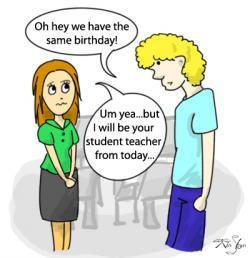
As senior Gabriela Acosta walks into her Advanced Placement (AP) Psychology classroom, a tall female teenager with short brown hair and a button up shirt stands at the front of the board talking to teacher Julia Smrek. While students continue to file into the room and take their seats, Acosta assumes the new girl to be a transfer or guest from another school. However, Smrek instead turns around and introduces the guest as Ms. Emma Aguilar, the class's new student-teacher for the semester from the University of Maryland. What Acosta soon came to discover in her AP Psychology class is that she and her new student-teacher would not only share the same classroom, but also the same birthdate.
AP Psychology, like any AP course offered throughout the country, is designed to be taught at a higher level than a normal high school class. According to The College Board website, when taught well, AP classes are supposed to be as challenging as many freshman-level college courses. These subjects can also offer a potential college credit if the individual scores well on the culminating national AP subject-specific test. As student-teachers are being granted permission to teach these supposed college-level classes, the relationship and responsibilities between the teacher and the student-teacher must be established in order for the class to properly meet AP class requirements and rigor.
The alarm arises over how an undergraduate college student can properly teach what is supposed to be a college-level class. Student-teachers are placed in real schools in order to get the experience of what it will be like to teach a class once they complete their degree. However, there is a nation-wide concern that these AP courses are not proper equivalents to freshman classes as these "college courses" are taught by students themselves. Despite the teacher's responsibilities to properly monitor the class and make sure that the College Board-approved AP course curriculum is being met, there is a fine line that is easily crossed when it comes to grading and in-class instruction.
The integration of college students interacting with high school students in pre-professional student-teacher programs creates a unique and sometimes difficult situation for older high school students. These relationships are frequently strained as high school students often find themselves struggling to succumb to the instruction of a similar and sometimes same-aged student-teacher. Acosta admits that to sit in a classroom and be lectured and graded by someone her exact same age is a difficult feat she is not accustomed to. "It is hard," Acosta said, "to maintain that level of authoritative respect when in my mind she is on my same level."
According to the Montgomery County Public Schools (MCPS) department of Human Services, the definition of a student-teacher is a college student who is completing the final field experience prior to entering the teaching profession and has been assigned to practice teaching. Any student-teacher who gains the privilege to work as a student teacher in MCPS has assumedly successfully completed the appropriate rigorous courses to earn their position. However, this does not necessarily mean that they have the proper requirements or background to teach AP courses. Many AP teachers go through a variety of classes, lectures and workshops in order to be fully equipped to teach their class. Undergraduate student teachers cannot fulfill this commitment as they are trying to satisfy their own graduation requirements.
If a teacher is assigned a student-teacher to help assist their in-class instruction with an AP course, they must take the personal responsibility of closely monitoring the student-teacher's instruction, grading and classroom behavior. Although student-teachers are there to learn, the main priority for the teacher must be directed toward the AP students who must learn the material properly in order to do well on the test.
According to AP National State Local (NSL) government teacher David Swaney, the capability of a student-teacher teaching an AP class is "totally dependent on the student-teacher. Many student-teachers are right out of undergrad and are still academically under-prepared to teach at the AP level, but many are grad students with an academic depth of knowledge capable of teaching at that level."
This addresses another area of consideration: the difference between an undergraduate student-teacher and graduate student-teacher. Based on each individual college student's experiences and courses taken throughout school, they may in fact be prepared to teach an AP class. However, it is questionable that just four years after graduating from high school, undergraduate students will possess the qualifications to teach a college course.
However, despite the administrating teacher's role in classroom instruction, students must take responsibility in recognizing authority regardless of some possible tension that may exist between two parties of teenagers. As long as each AP teacher recognizes the risk and responsibility in allowing both graduate and especially undergraduate student-teachers to teach an AP course, teachers, student-teachers and students can successfully achieve balance in this difficult relationship.
AP Psychology, like any AP course offered throughout the country, is designed to be taught at a higher level than a normal high school class. According to The College Board website, when taught well, AP classes are supposed to be as challenging as many freshman-level college courses. These subjects can also offer a potential college credit if the individual scores well on the culminating national AP subject-specific test. As student-teachers are being granted permission to teach these supposed college-level classes, the relationship and responsibilities between the teacher and the student-teacher must be established in order for the class to properly meet AP class requirements and rigor.
The alarm arises over how an undergraduate college student can properly teach what is supposed to be a college-level class. Student-teachers are placed in real schools in order to get the experience of what it will be like to teach a class once they complete their degree. However, there is a nation-wide concern that these AP courses are not proper equivalents to freshman classes as these "college courses" are taught by students themselves. Despite the teacher's responsibilities to properly monitor the class and make sure that the College Board-approved AP course curriculum is being met, there is a fine line that is easily crossed when it comes to grading and in-class instruction.
The integration of college students interacting with high school students in pre-professional student-teacher programs creates a unique and sometimes difficult situation for older high school students. These relationships are frequently strained as high school students often find themselves struggling to succumb to the instruction of a similar and sometimes same-aged student-teacher. Acosta admits that to sit in a classroom and be lectured and graded by someone her exact same age is a difficult feat she is not accustomed to. "It is hard," Acosta said, "to maintain that level of authoritative respect when in my mind she is on my same level."
According to the Montgomery County Public Schools (MCPS) department of Human Services, the definition of a student-teacher is a college student who is completing the final field experience prior to entering the teaching profession and has been assigned to practice teaching. Any student-teacher who gains the privilege to work as a student teacher in MCPS has assumedly successfully completed the appropriate rigorous courses to earn their position. However, this does not necessarily mean that they have the proper requirements or background to teach AP courses. Many AP teachers go through a variety of classes, lectures and workshops in order to be fully equipped to teach their class. Undergraduate student teachers cannot fulfill this commitment as they are trying to satisfy their own graduation requirements.
If a teacher is assigned a student-teacher to help assist their in-class instruction with an AP course, they must take the personal responsibility of closely monitoring the student-teacher's instruction, grading and classroom behavior. Although student-teachers are there to learn, the main priority for the teacher must be directed toward the AP students who must learn the material properly in order to do well on the test.
According to AP National State Local (NSL) government teacher David Swaney, the capability of a student-teacher teaching an AP class is "totally dependent on the student-teacher. Many student-teachers are right out of undergrad and are still academically under-prepared to teach at the AP level, but many are grad students with an academic depth of knowledge capable of teaching at that level."
This addresses another area of consideration: the difference between an undergraduate student-teacher and graduate student-teacher. Based on each individual college student's experiences and courses taken throughout school, they may in fact be prepared to teach an AP class. However, it is questionable that just four years after graduating from high school, undergraduate students will possess the qualifications to teach a college course.
However, despite the administrating teacher's role in classroom instruction, students must take responsibility in recognizing authority regardless of some possible tension that may exist between two parties of teenagers. As long as each AP teacher recognizes the risk and responsibility in allowing both graduate and especially undergraduate student-teachers to teach an AP course, teachers, student-teachers and students can successfully achieve balance in this difficult relationship.


Discuss this Article
In reality AP students have demonstrated a degree of self-intitiative that perhaps makes them best suited to succeeed beneath the tutelage of a student teacher. All too often students who do not take AP courses are most likely to receive instruction from the least experienced teachers despite needing the greatest amount of support.
Nationally, 50% of teachers quit the profession within 5 years of beginning and in MCPS 35% of teachers leave within 5 years according MCEA. Ensuring future high quality instruction is imperative and only possible if future teachers receive relavent student teaching opportunities. Hopefully such experiences will be far and few in between many courses taught by experienced teachers. Unforutnately, that means that some students may have to adapt to their relatively young and inexperienced instructor. The real world is no different!
Ms. Brason would be better off encouraging her peers to take responsibility for their own learning as she qualifyingly states at the end of her article. Even in our postmodern era where it appears as though one can gain status through cries of victimhood the fastest path towards a meaningful life, academic or otherwise, involves accepting responsibility for your own actions.
Ms. Branson and her peers could use their energy more constructively to persuade lawmakers to reform education so that teaching becomes a more desirable and respectable profession.
An AP class is a college level course, one where the student is not expected to merely know the course, but to be able to build further knowledge upon it. With a student teacher, questions cannot be fully answered.
A student teacher does not have the knowledge or experience to expound on the items in the textbook, only to recite textbook definitions.
Students, already struggling with balancing school, social development, and adolescence, should not be the ones trying to get teachers a raise. The teachers are the ones who are responsible for trying to improve their own lives.
This story took a lot of guts... thanks for showing some backbone SCO.
unfortunately!! grossman
young student teachers demand respect but yet never seem to give to their students!!!
Most students would rather not be taught by a young and inexperienced instructor. It is a pity that the "real world is no different" but that is no excuse for a completely inadequate teacher to ruin a course for a classroom of students. No matter what Mr. Grossman may believe, a student's education in the academic subjects is much more important than learning the single idea that there are incompetent people in society.
Even if the student teachers may become better teachers as a result of teaching AP courses, it is not worth the price. An inexperienced teacher can destroy a course: I've had one last year who had no clue what he was doing. Mr. Grossman may think that it may be worth it to sacrifice a few current students so that future students may have a better teacher. However, most teachers would not share this opinion because their students actually matter to them, every single one. Education is not a business that seeks to maximize profits.
Students are not pawns to be thrown away in gambits. Every single one is important and to destroy any of their education is unjustifiable, no matter how it may help a student teacher and future students.
Your arguements would be much more convincing if you weren't so condescending. Pointing out the mistakes in every post before you and slamming this article is worse than pointing out a small spelling mistake.
Instead we should tell students to go to school, spend their youth listening to a student teacher who fails to act mature, has "pet peeves" in her first year of teaching, and knows only what comes from a textbook.
Shall we sit and suffer or take action to change it?
Indeed we are "whining"- in the real world, an issue that no one "whines" about is not dealt with. Labor unions "whine" about poor conditions, low salaries, so that they get what they want.
@ Future Student teacher
As a magnet student, we understand bad teachers. We have magnet teachers who give us huge projects, then base our grades on completion, teachers who tell irrelevant stories, teachers who lose our papers. We do not complain, because when we need help on our Senior Research Project or an important competition, they have the experience and knowledge to help us.
Yes, we are needy - we desire a higher, or at least satisfactory education, one where we can spend time researching at NIH rather than self-studying Psychology. If we are taking an AP class, we expect to be relived of the burden of self-studying, not to serve as $400 lab mice.
I expect you to fail as a student teacher if you believe having a low standard of teaching is fine for students. America, with its already failing education system, does not need more pessemistic slackers like you.
In my eyes (based off of both the article and several of the comments I've read), this is an issue of whether we should nurture the student teacher with a class of dilligent (if needy) students, or nurture the bright students with an experienced teacher. Now, I can't say if the AP Psychology classes that would have been taught by Ms. Smrek would have necessarily been any more intellectually stimulating than those taught by Ms. Aguillar (although I can say from first hand experience, I don't think that would be hard), but I think that the needs of the 60-some students far outweigh those of a 19-year-old student teacher.
Big Chief
Since you are much more intelligent than all of us, I believe you should not expect us to accomplish the same great things as you, namely being able to learn an entire subject with minimal teacher supervision. Most people need teachers to introduce a topic and explain most of the basics before they can adequately read the material by themselves. For example, Albert Einstein had several teachers. Teachers are not useless to most of us underlings. Admire yourself in your mirrors all you want but do not force onto us high expectations that you obviously did so well under. We are simply not as capable of you intellectually.
Future Student teacher,
One wrong and another wrong does not cancel each other out. You agree that TA's are not good teachers. That does not make bad teachers in high school alright.
Stop trying to justify your position and existence. The position is set for you to be hated. You are not wanted in the classroom by students. You are inexperienced and cannot teach very well. All the while, there is a veteran teacher in the room who understands the material very well and can teach the course many times better.
We are needy and we are correct to be needy. Not all subjects are as simple as the ones you have taken. Many courses require teachers to introduce the basics to the students and spark the student’s interests. When all your students do not do as well as they would like to, do not blame them for their lack of interest and self-initiative. Blame yourself for your incompetence. A good teacher can make all his students interested in the material no matter who his students are.
You not as important as you think. Your experience is not worth the educations of a classroom of students. Find better ways to help yourself but do not do it in a way that would hurt me.
I think the fact that students teachers are so close to their students' ages but in a higher position make students feel as if the student teacher is generally more condescending and/or unnecessarily stricter (abusive of their "power") than their other older teachers, even if this might not be the case.
So, basically, I don't think it's a question about competency. I believe students who are complaining about how they don't feel like they're learning anything from their student teacher are just unwilling to learn and take the class seriously.
you claim to want tons and tons of good teachers, apparemtly enough for every classroom, but are actively denying this from happening by preventing them from getting any experience.
nobody said teachers are useless, but you do need to do some work on your own. taking an AP course does NOT mean you are suddenly free from any coursework beyond class time (as somebody posted). a failing student is virtually always a combination of poor teachers and poor students. rarely is one side totally responsible, though that does happen.
"A good teacher can make all his students interestd in the material no matter who his students are"
this is simply ludicrous. what an absurd notion. to expect this out of any teacher is borderline insanity.
I can't wait till you kids get to college. if this is "suffering" for magnet/cap juniors and seniors, the elite universities you are going to are going to absoultely chew you up and spit you out.
Which means what if everyone assumes that position?
"The position is set for you to be hated. You are not wanted in the classroom by students."--mango
Because you know sooo much about all students....
and why the anonymity?--with such accusations and challenges, why not post who you are?
If its birthyear, then is Gabriel behind or the stud tchr ahead?
Now then, to the issue.
(I have actually made an effort to read the article this time)
The issue of the AP course instructors often appears propped up against the issue of AP curriculum. The issue of graduate or undergraduate teachers teaching AP classes may be correctly subsumed under this broader subject. How indeed, are teachers qualified to teach AP classes? And can a certain degree qualify someone to teach a class on a subject? Certainly, comprehension does not necessarily translate to ability to teach a subject. As a matter of opinion, we may say a one teacher is superior in this respect or that, or that one lacks ability in one field. As explicit opinion, this is infinitely debatable. However, scaling or defining empirical knowledge proves challenging. Therefore, attempting to qualify teachers merely by experience is complicated and it produces unreliable results. Teachers who have taught for twenty years could still be called bad teachers by student opinion, and undergraduate teachers could be considered excellent. We must look past this form of debating to reach a worthy conclusion.
Everything that I state henceforth assumes the reader agrees with the mathematical probability of prediction, meaning that firstly, we may say, in terms of mathematical probability, a teacher with more experience in their field will more reliably be able to teach a class than one not so experienced. Teaching requires use of many different skills, not pure subject knowledge. A textbook cannot instruct a class. Teachers benefit from other things: social skills, diligence, charisma, etc. Lack of these doesn’t mean incapability of teaching. They are merely sweeping categories that often assist the profession.
We can classify teacher knowledge into two categories relating to their profession: empirical and subject matter. Subject matter knowledge is exactly as it sounds. Ability to instruct students, convey subject matter, and conduct a classroom rests almost solely on empirical knowledge. Empirical knowledge is difficult to measure. We may say: the probability of a given teacher being “good” at teaching is greater with more experience, or that a Master’s degree is superior to a Bachelor’s. But this doesn’t hold true for all cases. Other factors contribute heavily to a teacher’s ability, including environment, curriculum, and students, to name a few.
To speak to the issue of what students have a right to expect from AP teachers, we may say this: subject matter that is more complex and which requires greater effort to comprehend is by nature more difficult to teach, assuming all other variables (student interest, curriculum pace, class environment, student mood, etc.) are ideal. Therefore, by its nature, AP subject matter requires an understanding more difficult to obtain by the educator. Like every other pay scale, that of teachers should adjust to scarcity. The teaching positions harder to fill due to a limited number of qualified teachers should have benefits. Otherwise we risk undermining a system that rewards greater accomplishment, and people won’t fill these more difficult positions because they require more work by the aspiring teacher.
What mostly differentiates school from self-teaching is the presence of an educator. Students who attend school do so with the assumption that an educator will be present and competent. Without this, the benefits and distinctions of school become invalid and school loses this distinction. If the educator does not possess what students expect of them, their ability is reduced in the student’s perception. Thus, we have this article by Ms. Branson about teacher qualifications. Student opinion of a teacher formed in youth and therefore very difficult to alter. Students expect an educator to behave a certain way and possess certain qualities. Anything less incites bad opinion, by nature. Now, student opinion would matter nothing more than janitor opinion except for the fact the students are what the teacher must educate. Therefore, not meeting expectations results in student dissatisfaction, regardless of how capable a teacher may be. In conclusion, all we can derive from this argument unfortunately is that the student’s opinion of a teacher influences their ability to educate. Teachers are expected to know the subject matter and how to run a class. Students must pay attention and to do work on time. If either side slacks, they’ll likely blame the other. Frustrated teachers blame incompetent student or curriculum, and distraught students blame the teacher or curriculum. The teachers and the students are the humans. Curriculum is merely a set of guidelines. The topic of debate is the teachers and students, not curriculum, so we speak no more on that topic.
If the reader will allow the metaphor we can imagine the class as an ocean, and the student and teacher two swimmers lost at sea. Neither can reach the shore under his own power; they must cooperate. If one flounders, the other must help him until he can swim again. And the one floundering must take care; if they do not right themselves they can drag the both of them down.
On the last part of the issue which regards the job of the student to look past distaste of a young teacher, we say this: student nature is inflexible and such disrespect and distaste is natural. That does not however, make it unchangeable, or at worst ignorable. Recall that students must agree to be taught, to learn. If they refuse this, all a teacher does is useless. The students who demand a quality educator are better; they show the desire to learn and be taught, merely with the condition that the teacher be competent. Yet it still falls on the student to circumvent any opinion and attempt to derive all they can from the instructor presented. If they wish to complain they may do so, however, that should not prevent them from still attempting to learn and complete objectives.
I await your rebuttals and complaints, my fellow students and staff.
I also wish to inquire about your use of the word "victimhood". Nowhere in Branson’s article do we see student complaints, Branson attempt to excuse students of their responsibilities, or, as you stated, the appearance of “hurtful and trivial accusations”. The point of this op-ed is to bring forth a pertinent issue. In covering it however, Branson qualifies her terms, unlike you, and does not group all student teachers together and call them under qualified. In AP classes, regardless of how bright or infinitely self-motivated a student is, the teacher is a vital component to success. Textbooks and AP prep books do not take the place of a teacher capable of answering student’s questions and bringing learning to a level past facts and figures. I acknowledge it is on the student to make the effort to learn, but you seem to deny any teacher role or responsibility. With such a perspective, how could teaching ever be a respectable profession? It seems here you as a teacher are playing the victim card, not vice versa.