July 18, 2008
Modified bus policy makes no cents
For Montgomery County Public Schools (MCPS) students, a new bus policy means it is time to get out the old walking shoes. Old MCPS bus policy stated that high school students who live within two miles of their schools must find alternate transportation, as must middle school students who live within one and a half miles of their schools and elementary school students who live within one mile of their schools. A modified policy will allow Superintendent Jerry Weast to bend these limits when necessary if diesel costs place undue financial strain on the school system. The Board-approved plan has been modified to include a three-week period for public comment after Weast suggests a route change, which had been completely left out of the original version. Even with this addition, the new policy will compromise student safety, burden taxpayers and hurt communities in myriad ways.
A school district already scaling back on county resources and programs in so many ways, including the budget cuts being dealt to schools around the county, is surely not qualified to make the claim that eliminating the most basic of conveniences - student transportation to and from school - will significantly reduce financial strain on it. Proponents of the policy change assert that cutting transportation is a more effective solution to budgetary issues than cutting education-related spending on resources such as textbooks. They overlook the fact that nothing could be more directly related to education than ensuring that a student gets to their institution of learning in a safe and timely manner. In fact, school buses are essential for many students' academic success. Unmotivated students might not feel compelled to attend school without a bus to take them there and instead end up compromising their academic futures by engaging in other dangerous or criminal activities.
MCPS financial issues lie only at the surface of the controversial proposal, though. While the new measures would appear to undercut pollution from buses, parents who oppose the changed policy would likely end up driving their children to school, exacerbating pollution and contributing to traffic.
A blatant disregard for the safety of students is perhaps the most disturbing implication of the new policy. Young students, especially, run the risk of being hurt while walking and may have to be supervised by adults, whose busy schedules will be disrupted. Children are also vulnerable to kidnappers and predators while walking unsupervised. The dangers that vehicles pose to students walking to school could be compounded by winter road conditions as well as early morning school start times, which will mean walking in darkness for many high school students. Walking also enhances risk for disabled students or students with medical conditions. For those students able to walk, exercise would be a benefit of the policy change – but other measures, such as increased physical education requirements, would accomplish the same outcome without coming at the cost of student safety.
In truth, it is the people impacted by the policy who should have had a say in making it: the students whose safety is at risk, their overstretched and worried parents and the communities around schools that will face more pollution, more traffic and potentially more vagrant youths not attending school. In the meantime, the county continues to spend extravagantly on less urgent projects such as installing an artificial sports turf at a local high school, continuing to increase the burden on taxpayers while proposing that the welfare of MCPS students be at stake every morning and afternoon.
There are ways to remedy MCPS's chronic budgetary difficulties besides completely doing away with a means of transportation provided to several students around the county. If bus fuel costs must be cut, the number of stops in a neighborhood can be reduced without completely eliminating the service to everyone within walking radius – and this diminution in expenses must be supplemented by smarter spending and fundraising on the part of the county. In the end, there are some things money can't buy – a healthy environment, student safety and peace of mind for county residents. The price of diesel may be going up, but it does not outweigh the price of endangering our students and communities on a daily basis.
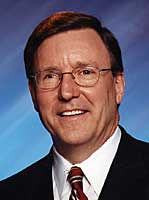
Superintendent Jerry Weast, above, commended the Board of Education for approving his new bus policy in June. Photo courtesy of the Board of Education.
A school district already scaling back on county resources and programs in so many ways, including the budget cuts being dealt to schools around the county, is surely not qualified to make the claim that eliminating the most basic of conveniences - student transportation to and from school - will significantly reduce financial strain on it. Proponents of the policy change assert that cutting transportation is a more effective solution to budgetary issues than cutting education-related spending on resources such as textbooks. They overlook the fact that nothing could be more directly related to education than ensuring that a student gets to their institution of learning in a safe and timely manner. In fact, school buses are essential for many students' academic success. Unmotivated students might not feel compelled to attend school without a bus to take them there and instead end up compromising their academic futures by engaging in other dangerous or criminal activities.
MCPS financial issues lie only at the surface of the controversial proposal, though. While the new measures would appear to undercut pollution from buses, parents who oppose the changed policy would likely end up driving their children to school, exacerbating pollution and contributing to traffic.
A blatant disregard for the safety of students is perhaps the most disturbing implication of the new policy. Young students, especially, run the risk of being hurt while walking and may have to be supervised by adults, whose busy schedules will be disrupted. Children are also vulnerable to kidnappers and predators while walking unsupervised. The dangers that vehicles pose to students walking to school could be compounded by winter road conditions as well as early morning school start times, which will mean walking in darkness for many high school students. Walking also enhances risk for disabled students or students with medical conditions. For those students able to walk, exercise would be a benefit of the policy change – but other measures, such as increased physical education requirements, would accomplish the same outcome without coming at the cost of student safety.
In truth, it is the people impacted by the policy who should have had a say in making it: the students whose safety is at risk, their overstretched and worried parents and the communities around schools that will face more pollution, more traffic and potentially more vagrant youths not attending school. In the meantime, the county continues to spend extravagantly on less urgent projects such as installing an artificial sports turf at a local high school, continuing to increase the burden on taxpayers while proposing that the welfare of MCPS students be at stake every morning and afternoon.
There are ways to remedy MCPS's chronic budgetary difficulties besides completely doing away with a means of transportation provided to several students around the county. If bus fuel costs must be cut, the number of stops in a neighborhood can be reduced without completely eliminating the service to everyone within walking radius – and this diminution in expenses must be supplemented by smarter spending and fundraising on the part of the county. In the end, there are some things money can't buy – a healthy environment, student safety and peace of mind for county residents. The price of diesel may be going up, but it does not outweigh the price of endangering our students and communities on a daily basis.
Tweet
Share on Tumblr


Silver Chips Online invites you to share your thoughts about this article. Please use this forum to further discussion of the story topic and refrain from personal attacks and offensive language. SCO reserves the right to deny any comment. No comments that include hyperlinks will be posted. If you have a question for us, please include your email address or use this form.
First, what serious sacrifices is this author suggesting we make? If bus routes should not be significantly changed, what should be changed instead? Obviously, any cuts in funding in textbooks or other teaching materials (computers, science and tech ed equipment) would be seen as a step backwards; but something must be done given these financial conditions. Should it be teachers? Or salaries? While it is certainly true that a great deal of cuts have already been implemented, it does not mean we are entitled to stop resolving the financial strain. However, the ideas proposed by the author do not go far enough. Although “Smarter spending” and “removing number of stops in neighborhoods” are quite pleasant to the ear, they offer little in tangible solutions. Plus, if cuts are so bad then the only other sensible plan of action would be to raise revenue otherwise known as raising taxes. If such a thought is also dreadful, then by all means call it a fundraiser…its still taking your money but just in a nicer way. Still that does not mean we cannot be upset with Central Office. There are quite a few people that certainly deserve the axe and some of their policies have certainly backfired if not downright stupid.
Second, why must parents always be concerned about childhood predators? It is precisely this paranoia that has destroyed, if not severely restricted, the activities that define childhood. There are certainly a lot more important, and more pervasive, problems that need to be dealt with, such as childhood obesity and childhood addiction to video games, than some child stalker. Just like in national issues people tend to overemphasize the occurrence of some problems (terrorist attack) and de-emphasize more relevant ones (global warming, obesity).
Third, if parents are the ones who are subverting the “environmental friendly” policy then can we really blame the school board? Plus, should we not implement some policy because others might act counter to it or find a loophole around it? Should we not raise taxes because the rich will find a way to hide it form the government? Should we not tighten environmental regulations because companies will find a way to keep polluting? While such consequences should certainly be taken account, it is the problem of the public, and not so much MCPS, for being so obsessive compulsive of having to drive their kids from home to the bus stop or home to school.
Fourth, there are a number of things that must be asked about safety. About “walking in darkness”, is the author suggesting that high school students are not smart enough to do such a task? Also, wouldn’t it also be logical that school closing and delays, during winter months, would take into account this increase in walking? Moreover, although some young children might need some supervision, parents should also stop being so overprotected as well. It might be extremely beneficial to actually make parents give more trust to their younger children then always expecting them to be unable to take on the task at hand. (And this will certainly force parents to think about giving trust as they will have to choose between work and supervising—not all inconveniences are bad) Still, in some situations walking could be hazardous, such as crossing a busy street without crosswalks, and it is at these places that MCPS can provide additional signs, traffic guards, or busing. But, this problem should not be the overriding factor over this decision.
Finally, just a few other remarks to make. The comment over “Unmotivated students” was lacking for a number of reasons. If getting the chance to ride the “school bus” is the only reason they come to school, then there is something much worse that needs to be addressed then just the school buses. Plus, just because a student is not at school does not mean they are out doing illegal or criminal activity; avoid such direct causation. The remark and then, slight, rebuke over exercise was also lacking. Although it can be considered “safer” to do exercise in school, the consequences for adding more physical education requirements are many: from more classes to more teachers to less elective selection. At least walking to school is a simple activity that happens twice a day five times a week.
Hopefully this will be some food for thought…
~The Questioner
I'm not sure that the distance of two miles is anything to get upset about. If you lived in more rural parts of Maryland, instead of the Mo.Co. bubble, two miles to get somewhere wouldn't be such a big deal. The real issue is the lack of sidewalks available, especially in upcounty districts. With our traffic being as bad as it is, it could be very dangerous to walk along the shoulder, without the sidewalk buffer between speeding drivers.
For high schoolers and possibly middle schoolers in urban areas, the remaining metrobus policy could be of help in overcoming this county oversight. My concern is for the elementary school children. Parents with young children may not have the time in their day to walk their child to school and back (if, for example, they don't have a car).
Which leads me to a question for the Questioner...
In your forth objection, you claimed,
"although some young children might need some supervision, parents should also stop being so overprotected as well."
I assume you mean overprotective. Parents are not just going to force their 6-year-olds to grow up prematurely and push them out into mile-long treks through possibly adverse conditions such as inclement weather or unsafe streets. Parents cannot always accommodate to please the county.
Also, "in some situations walking could be hazardous, such as crossing a busy street without crosswalks, and it is at these places that MCPS can provide additional signs, traffic guards, or busing."
Weast is proposing cutting buses in order to save funds. Do you honestly believe they will take that money, then turn around and spend it on new safety provisions. (By the way, MCPS doesn't control where traffic signs or crossing guards are placed).
You made many interesting points including the equipment and teacher budget cut issues, but I still don't think safety of students should be compromised, especially if they are in grades 5 or below.