Words of advice from a former monk and journalist living in Silver Spring
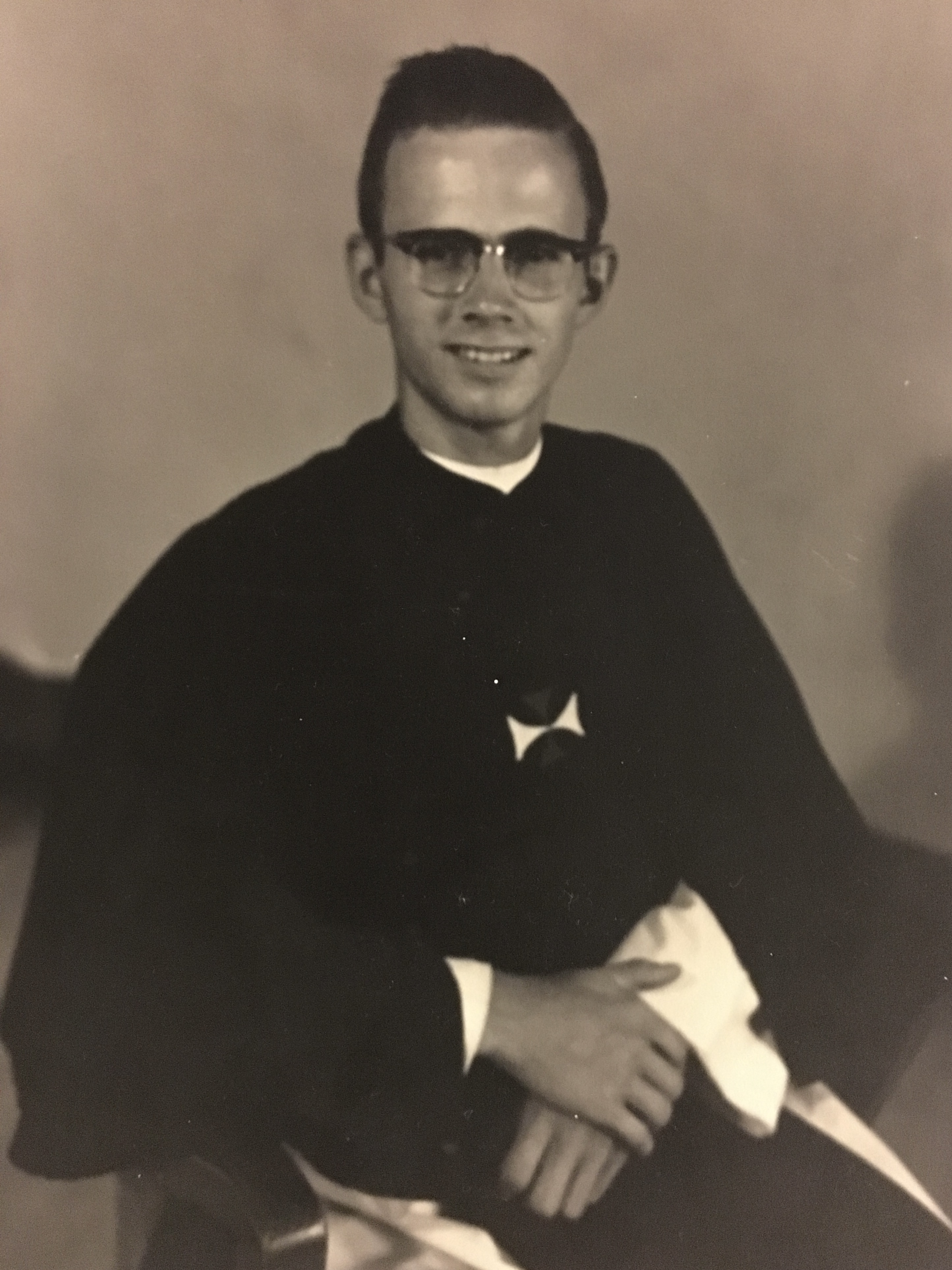
Jerome Ernst, now a journalist at age 88, entered the monastery in his 20s.
Amid bustling hallways, constant notifications, and mounting academic stress, silence is a rare commodity for Blair students. Even in moments of solitude, teens struggle to quiet the constant chatter of their own thoughts—worries about grades, social pressures, and the endless buzz of the digital world can often overwhelm our minds. Escaping the noise and monotony of modern life, even for a moment, can sometimes feel like a herculean task.
However, for former catholic monk and journalist Jerome Ernst, that very silence was a way of life. Over the course of his ten-year stay with the Crosier Fathers, a group of Catholic priests and brothers founded in the Middle Ages, he learned to live as a monk, allowing silence, prayer, and study to guide his daily life. Even when he left the monastery and began anew as a journalist, he took with him the lessons he learned as a monk––lessons that are more than relevant today.
Structured routines
Most monks and priests follow the Liturgy of the Hours (also known as the Breviary), a prayer routine consisting of five daily periods of prayer that give structure to the day. “We would wake up at 5:20 a.m., and we always started the day with the breviary and then mass,” Ernst says. “We also studied Latin and Greek six days a week, all of which helped us keep focused on our routine.”
As Ernst became more committed to monastic life, the rules and structure tightened. Minor silence (talking prohibited unless absolutely necessary) was enforced during the daytime, and major silence during the night (talking prohibited completely). These routines of prayer, study, and contemplation instilled in Ernst a discipline that he’s kept with him even after leaving the monastery. “I learned the discipline of that life,” he says. “Whether it’s in reading, going to mass, or doing work, I’ve learned to discipline myself through the strict routine of monastic life.”
Simplicity
Living as a monk also means stripping life down to its basic necessities and often making vows of charity or chastity. Ernst lived in a 40-person dormitory for most of his time as a monk, admiring the bareness of shared poverty. “For most of us, it was just ‘locker, bed, locker, bed’ over and over,” he says. For Ernst, this lack of physical distraction allowed him to look beyond himself. “I was able to see beyond the immediate physical stuff and see the bigger picture,” he says.
Community
Despite the rules of silence and prayer, Ernst’s time with the Crosier Fathers was also deeply social. He encountered the works of famous authors such as G.K. Chesterton and Gerard Manley Hopkins, wrote for the monastery newspaper, and participated in communal basketball games. Ernst even struck up a deal with a fellow monk, allowing him to smuggle cartoons into the dormitory. “We would exchange books,” he says. “I would give him a Chesterton, and he would get a cartoon, and we would go back and forth.”
This sense of community provided a stable foundation for Ernst to develop intellectual curiosity, as the monks shared communal meals and participated in spiritual readings together. These shared experiences remain with Ernst to this day.
Returning to public life
After ten years in the monastery, Ernst transitioned back into the secular world, but he did not leave his values behind. He earned degrees in journalism and began traveling the country as a writer, joining the Civil Rights Movement after the Second Vatican Council in 1965. He traveled to the March on Selma, inspiring a lifelong career of community organizing. “When I went to Selma, I was scared stiff,” he says. “I was alone, and while I was there, I wrote a story about the march. Since then, I’ve been doing civil rights organizing for the rest of my life.”
Closing advice
Ernst, now 88 years old, recognizes the intense stress and confusion that often come with youth. “I think the kids, or really anybody at any school, are looking for meaning in life,” he says. “You know, what's it all about? And how can we become more aware of reality?” Having several children graduate from Blair adds to his concern.
However, Ernst believes that his monastic training in routine, simplicity, and community has allowed him to reach a new perspective. Drawing on knowledge he picked up in the monastery, Ernst believes that looking beyond material and temporal matters and contemplating the unknown will lead to peace. “Hopkins talks about how there is freshness deep down, things we can’t see, that are beyond the immediate material and temporal world,” he says. “We should look forward, not backward, and always be involved in developing our overall consciousness.”
In a world that rewards speed, noise, and constant productivity, Ernst’s advice is almost countercultural: rather than racing to keep up with the world, we should slow down and focus on ourselves. It’s simple advice, but perplexingly hard to follow.
Joe Newman. Hi, I'm Joe Newman. I'm a senior here at Blair and this is my second year on SCO. I play tennis, soccer, and I run cross-country. I'm also really into religion and philosophy, and I love having deep discussions with others. Oh, y no se … More »
Please ensure that all comments are mature and responsible; they will go through moderation.
