Sept. 28, 2008
The Promethean curse
Blamed for bringing evils, pains and diseases to mankind; heralded as the bringer of fire; and defamed as a swindler, thief and trickster - the immortal Prometheus lived a life condemned to eternal pain and retribution for his thievery and deception. He was a scammer draped in a hero's cloak much like the boards that bear his name.
The new Promethean Activboards, made by Promethean World, that have been installed across the county have the deceptive allure of augmenting education while being secretly wrapped in a large tax bill for an ailing Montgomery County economy. Already facing a $250 million shortfall for fiscal year 2010, the county council approved of a roughly $13.5 million expenditure ($3.364 million per year over four-years) on the futuristic looking boards as part of a $19.6 million technology modification this year for Montgomery County Public Schools (MCPS) according to figures from The Washington Post and Michael Cady, Director of the Department of Financial Operations for MCPS.
Installed to engage students as well as teachers, the Promethean boards have been installed in 65 percent of classrooms in over 54 schools across the county, according to Cady. While meant to engage, no formal, nonpartisan study has been conducted on the boards to show that students or teachers are more involved in the classroom when a Promethean board is present.
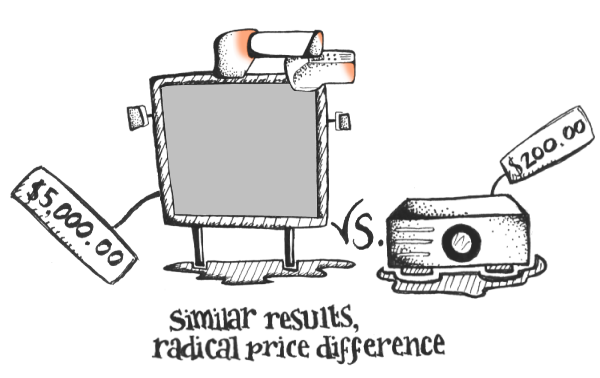
Essentially, a Promethean board is "just a big mouse," Cady said - a mouse with a price-tag of over $5,000 per unit. The boards do, however, have features unused before in the Montgomery County classroom - active vote, interactive interface and stylus pen technology - because they were already integral parts of the classroom. The active vote is simply a fancy word for a quiz; interactive interface, a nice synonym for a dynamic teacher; and stylus pen, a glorious disguise for markers.
Cumbersome, intrusive and overbearing, the Promethean boards, framed in fiery orange plastic, jut out into the classroom with all the inconspicuousness of a mammoth computer from the technologically primordial fifties. Though the boards, if widely accepted, are likely to be refined, shrunk and made more practical in the next 10 to 20 years, the current boards provide limited benefits and offer numerous obstacles.
Blair's Promethean boards have been riddled with problems: defective wires, malfunctioning projectors and faulty speakers. Although these problems are expected of any newly installed technology, the real danger with the Promethean boards is their susceptibility to damage. The boards must be immediately cleaned if written on by a permanent or dry-erase marker otherwise it suffers reduced capabilities. The faulty parts have cost Blair faculty time and effort that could have been spent on instruction and planning. Instead, faculty has been left trying to fix or navigate around board problems.
With five training session, including four, three-hour comprehensive sessions by the county, in the four weeks since installation began many teachers are still in the dark on how to use the boards, even in the most basic manner. Many simply use the boards as a way to scroll through word documents, as an overhead projector or as an Internet projection, capabilities already available on school owned projectors.
The figurative dark is not the only place where the instructors are being left. As teachers begin committing time and resources to basing lessons around the boards, power becomes more of a necessity for education rather than an extra perk. If the power fails, as it did already once this year, the boards go with it as well.
The problem is not only when the boards do not work, but when they do. As concerns for a greener world seem to be a focal point of life from transportation to presidential elections, having 3,000 LCD projectors and Promethean boards humming throughout the school day will undoubtedly raise the electric bill of schools across the county. While the boards might seem beneficial to a county that already uses significantly more paper than other counties of the same size, there has been no reduction in paper usage and there are no plans to order less paper this year, according to Cady.
The Promethean boards have numerous deficiencies and little to offer, but the biggest problem is not with what they can and cannot do. The issue is that the county authorized $13.5 million in nonessential spending during a hiring freeze and time of general economic volatility. The county is willing to spend money it does not have, for a product it does not need. Prometheus may have brought humanity fire, but he also brought Pandora's pain, much in the same manner Promethean World has brought new technology at the price of deeper shortfalls.
The new Promethean Activboards, made by Promethean World, that have been installed across the county have the deceptive allure of augmenting education while being secretly wrapped in a large tax bill for an ailing Montgomery County economy. Already facing a $250 million shortfall for fiscal year 2010, the county council approved of a roughly $13.5 million expenditure ($3.364 million per year over four-years) on the futuristic looking boards as part of a $19.6 million technology modification this year for Montgomery County Public Schools (MCPS) according to figures from The Washington Post and Michael Cady, Director of the Department of Financial Operations for MCPS.
Installed to engage students as well as teachers, the Promethean boards have been installed in 65 percent of classrooms in over 54 schools across the county, according to Cady. While meant to engage, no formal, nonpartisan study has been conducted on the boards to show that students or teachers are more involved in the classroom when a Promethean board is present.
Essentially, a Promethean board is "just a big mouse," Cady said - a mouse with a price-tag of over $5,000 per unit. The boards do, however, have features unused before in the Montgomery County classroom - active vote, interactive interface and stylus pen technology - because they were already integral parts of the classroom. The active vote is simply a fancy word for a quiz; interactive interface, a nice synonym for a dynamic teacher; and stylus pen, a glorious disguise for markers.
Cumbersome, intrusive and overbearing, the Promethean boards, framed in fiery orange plastic, jut out into the classroom with all the inconspicuousness of a mammoth computer from the technologically primordial fifties. Though the boards, if widely accepted, are likely to be refined, shrunk and made more practical in the next 10 to 20 years, the current boards provide limited benefits and offer numerous obstacles.
Blair's Promethean boards have been riddled with problems: defective wires, malfunctioning projectors and faulty speakers. Although these problems are expected of any newly installed technology, the real danger with the Promethean boards is their susceptibility to damage. The boards must be immediately cleaned if written on by a permanent or dry-erase marker otherwise it suffers reduced capabilities. The faulty parts have cost Blair faculty time and effort that could have been spent on instruction and planning. Instead, faculty has been left trying to fix or navigate around board problems.
With five training session, including four, three-hour comprehensive sessions by the county, in the four weeks since installation began many teachers are still in the dark on how to use the boards, even in the most basic manner. Many simply use the boards as a way to scroll through word documents, as an overhead projector or as an Internet projection, capabilities already available on school owned projectors.
The figurative dark is not the only place where the instructors are being left. As teachers begin committing time and resources to basing lessons around the boards, power becomes more of a necessity for education rather than an extra perk. If the power fails, as it did already once this year, the boards go with it as well.
The problem is not only when the boards do not work, but when they do. As concerns for a greener world seem to be a focal point of life from transportation to presidential elections, having 3,000 LCD projectors and Promethean boards humming throughout the school day will undoubtedly raise the electric bill of schools across the county. While the boards might seem beneficial to a county that already uses significantly more paper than other counties of the same size, there has been no reduction in paper usage and there are no plans to order less paper this year, according to Cady.
The Promethean boards have numerous deficiencies and little to offer, but the biggest problem is not with what they can and cannot do. The issue is that the county authorized $13.5 million in nonessential spending during a hiring freeze and time of general economic volatility. The county is willing to spend money it does not have, for a product it does not need. Prometheus may have brought humanity fire, but he also brought Pandora's pain, much in the same manner Promethean World has brought new technology at the price of deeper shortfalls.


Discuss this Article
P.S.--Why are there still security codes on the comments? There haven't been any recent computer attacks, and all it does is encourage people not to post (therefore taking away the debate and interaction with the article that's so fun to read).
To a new and brighter future!
P.S. @ af: If you're interested in the amount of crud/spam SCO comments/mbhs.edu emails recieve, contact either technical staff. They'll be happy to complain about it to you.
also...arml = $15,000 and it was cut... 3 less promethean boards would have sufficed...
The Smart Company bid for the project and did not make anywhere as good of a deal as Promethean. And to [another complaining] magnet, These are long term investments. Because this technology will probably be kept for at least 15 years. Think about it as an economist. $4000 over 15 years is completely worth it. Plus the the money that went to this came from a capital fund not a school funs. Which is the same fund that goes to buying slot machines. SO STOP COMPLAINING!! YOU DON'T KNOW WHAT YOU ARE TALKING ABOUT!!!!
We do know what we're talking about. We know that 13.5 million dollars were spent on something that did not need to be purchased. Why that happened doesn't matter, we see something stupid happen, and we criticize it. We don't need to adapt to bureaucratic idiocy. The money's still being wasted.
An economist is not someone who thinks that buying a really expensive piece of crap that lasts for a long time will be worth it.
And anyway, liberal, you have no right to tell people to stop complaining. Complaints are what help the world improve.
I personally detest these boards not only for their cost. They are big, bulky, and do not provide enough space on which teachers can write. Several of my teachers have complained about the lack of writing room, despite the supposed "infinite" number of slides.
And then there's the difficulty of maintaining such boards. I heard that the bulb in the projector is extremely expensive to replace, and it doesn't last long due to the intensiveness of the light and long duration of use. And THEN there's the problem of the computer network being down. No computers, no place to write anymore since the Promethean boards are attached to the white board underneath.
I think the Director of the Department of Financial Operations for MCPS knew what he was talking about.
The federal eRate program, which I assume you are talking about, only pays for part of the cost of the boards...the rest costs the county $13.5 million over the next four years.
And no matter what government organization paid for the board, be it federal, state or local, it is taxpayer's money being frivolously spent.