January 25, 2009
Friending the folks
"How many of you have Facebooks?" research teacher John Kaluta asks his class. Too many hands shoot up for him to count. "Better question, how many of you don't have Facebooks?" Kaluta's eyes sweep twice across the room, only to see empty space.
Today, it is rare, and almost scandalous, for a teenager not to have a Facebook profile. Roughly 16,640,000 people aged 13 - 17 use Facebook in the U.S., with the adolescent age group rapidly expanding each day, according to senior anaylst Ben Lorica at O'Reilly Media, a media company that chronicles recent technology.
Although Facebook was initially targeted towards college students when it was created in Feb. 2004, the social network has expanded as a site for anyone. In fact, it is the older generations, those ages 26 - 59, which most heavily populate Facebook with 44% of the total 140 million users, according to Lorica. Among these adults, parents and teachers have been particularly enthusiastic in hopping onto the Facebook bandwagon. From checking up on their children on Facebook, to using the site as a way to keep in touch with old friends or students, parents and teachers alike have taken Facebook by storm – whether their students and children approve or not.
A friend request from mom
A casual click and junior Lucy Barr was shocked: "Robin Barr" had "Friend Requested" her on Facebook. Astonished, she tentatively clicked the "Confirm" button. Lucy was now "friends" with her mother.
Having survived a whole year with her mom on Facebook, Barr has become accustomed to the hovering presence. "There's something a little off-putting about having your mom, who by definition is supposed to be really 'uncool,' doing something that you like to do," she admits. "But then it's really her thing."
Barr admits that the two have experienced conflicts because of occasion cyber run-ins on Facebook. But instead of tearing the pair apart, Facebook has brought mother and daughter closer in a unique way. "It's getting easier to kind of coexist," Barr says.
Wiretapping the kids
But for junior Rachel Gelfeld and her brother, freshman Michael Gelfeld, coexisting on Facebook with their parents has not been a pleasurable experience.
Unlike Barr, whose mother gives her more privacy, Rachel and Michael's mother and father intentionally created Facebook profiles to monitor their children. Rachel was astonished when her parents told her about the creation of their Facebook accounts. "At first, it was kind of weird. I use Facebook socially, and I felt my parents were intruding on my social life," she says.
Rachel's desire for personal space is normal for adolescents, according to Anastasia Goodstein, author of "Totally Wired: What Teens and Tweens Are Really Doing Online." "Being a teen means individuating from your parents and creating your own identity. It's natural for teens to want some privacy and to be able to hang out with friends without their parents around," Goodstein explains.
For Rachel's brother, Michael, the need for privacy has forced him to double-check for undesirable content on his profile. "Sometimes I have to censor my wall-to-walls with my friends," he says. "I just don't want my parents reading my conversations."
Flocking to Facebook
Even though Rachel's mother, Elizabeth Gelfeld, started using Facebook just to check up on her children, she now uses her account almost every day as a way to reconnect with old friends and relatives.
Sophomore Sana Barclay's parents also use Facebook to keep in touch with their friends. Although Barclay's father, Chris Barclay, a member of the Montgomery County Board of Education, is friends with several Board members on Facebook, he uses Facebook mostly for communication rather than work. "It's more personal, like talking to college friends," Barclay acknowledges.
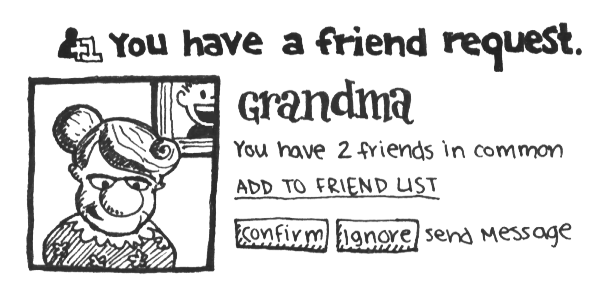
The site has recently attracted many adults because of its networking capabilities, according to Lorica. "Like other large social web applications, the network effects are the primary reason users of all ages join," he says.
Similar to Elizabeth, who joined Facebook because of her children, Magnet ninth grade engineering teacher John Templin also joined because of his younger acquaintances: his students. They encouraged him to create an account in order to share his experiences about field trips to Wallops Island, Va. and Rochester, N.Y., Templin recalls. In October 2008, he finally gave in to their demands.
Templin has found the site's many functions, including interaction with his peers and family, particularly beneficial. "I found out a lot of my friends are on Facebook. I keep in touch with my Irish friends I met on a trip to the Galapagos," he says. Like a typical Blazer, he also admits an infatuation with posting albums and pictures of previous field trips and conferences.
The fine line
Although his students persuaded him to get a Facebook, Templin does not accept all student friend requests. "I have a policy: open for review," he says. Templin accepts former students and alumni, but never friends current ninth graders in his classes.
Administrator and cheerleading coach Roxanne Fus also limits her student friends on Facebook. "My cheerleaders add me as their friend and I accept them. I also accept current or past students that I know as friends. I do not accept any requests of people I do not know, or students whom I do not have a personal relationship with," she says.
A friend of many of former and current Blair students, Templin has seen things on Facebook about his students he might not have necessarily wanted to know. "It's a little strange because you see all the statuses of students," he says. Although he does not want to intrude upon the privacy of his students, he acknowledges his obligations as an educator to report potential student problems, such as abuse, that he might spy on Facebook. "As a teacher, I have some responsibility if I see things," he admits.
Striking a balance between respecting privacy and taking responsibility is problematic for teachers, but also sticky for parents, even for more lenient ones like Barr's mother. "There was this one time that I forgot to log out of Facebook, and my mom looked at my friend's profile while I was still logged on," Barr remembers. "She saw an 'inappropriate' picture of one of my friends, and was like, 'I can't believe she puts these things on the Internet! I can't believe she's gotten so cheap!' "
Goodstein believes that healthy discussion can prevent potential family conflicts over privacy. She suggests that parents and children sit down and go through Facebook's privacy settings together to determine how much information to share.
For Barclay, discussing boundaries with her mom and dad about Facebook has been crucial to maintaining the privacy of all three family members' profiles. "We had a rule that as long as they don't friend me, it's okay," Barclay said. Since Barclay and her parents share a high level of trust, they are able to use Facebook independently.
An aging audience
In spite of their reduced privacy, both Rachel and Barr do not want Facebook to be exclusive to younger users. "I think that older people really should be allowed to have Facebooks. It shouldn't discriminate against what kind of people it's going to connect," Barr says.
With groups such as "Born in the 60's. Any of us out there?" (16,879 members) and "Unlike 99.99999999999% of the Facebook population, I was born in the 60s," (8,336 members), Facebook has clearly expanded beyond its original college roots. "It's just not a teen or college student hangout any more," Goodstein says.
Students beware – Facebook has become an adult's lair.
Today, it is rare, and almost scandalous, for a teenager not to have a Facebook profile. Roughly 16,640,000 people aged 13 - 17 use Facebook in the U.S., with the adolescent age group rapidly expanding each day, according to senior anaylst Ben Lorica at O'Reilly Media, a media company that chronicles recent technology.
Although Facebook was initially targeted towards college students when it was created in Feb. 2004, the social network has expanded as a site for anyone. In fact, it is the older generations, those ages 26 - 59, which most heavily populate Facebook with 44% of the total 140 million users, according to Lorica. Among these adults, parents and teachers have been particularly enthusiastic in hopping onto the Facebook bandwagon. From checking up on their children on Facebook, to using the site as a way to keep in touch with old friends or students, parents and teachers alike have taken Facebook by storm – whether their students and children approve or not.
A friend request from mom
A casual click and junior Lucy Barr was shocked: "Robin Barr" had "Friend Requested" her on Facebook. Astonished, she tentatively clicked the "Confirm" button. Lucy was now "friends" with her mother.
Having survived a whole year with her mom on Facebook, Barr has become accustomed to the hovering presence. "There's something a little off-putting about having your mom, who by definition is supposed to be really 'uncool,' doing something that you like to do," she admits. "But then it's really her thing."
Barr admits that the two have experienced conflicts because of occasion cyber run-ins on Facebook. But instead of tearing the pair apart, Facebook has brought mother and daughter closer in a unique way. "It's getting easier to kind of coexist," Barr says.
Wiretapping the kids
But for junior Rachel Gelfeld and her brother, freshman Michael Gelfeld, coexisting on Facebook with their parents has not been a pleasurable experience.
Unlike Barr, whose mother gives her more privacy, Rachel and Michael's mother and father intentionally created Facebook profiles to monitor their children. Rachel was astonished when her parents told her about the creation of their Facebook accounts. "At first, it was kind of weird. I use Facebook socially, and I felt my parents were intruding on my social life," she says.
Rachel's desire for personal space is normal for adolescents, according to Anastasia Goodstein, author of "Totally Wired: What Teens and Tweens Are Really Doing Online." "Being a teen means individuating from your parents and creating your own identity. It's natural for teens to want some privacy and to be able to hang out with friends without their parents around," Goodstein explains.
For Rachel's brother, Michael, the need for privacy has forced him to double-check for undesirable content on his profile. "Sometimes I have to censor my wall-to-walls with my friends," he says. "I just don't want my parents reading my conversations."
Flocking to Facebook
Even though Rachel's mother, Elizabeth Gelfeld, started using Facebook just to check up on her children, she now uses her account almost every day as a way to reconnect with old friends and relatives.
Sophomore Sana Barclay's parents also use Facebook to keep in touch with their friends. Although Barclay's father, Chris Barclay, a member of the Montgomery County Board of Education, is friends with several Board members on Facebook, he uses Facebook mostly for communication rather than work. "It's more personal, like talking to college friends," Barclay acknowledges.
The site has recently attracted many adults because of its networking capabilities, according to Lorica. "Like other large social web applications, the network effects are the primary reason users of all ages join," he says.
Similar to Elizabeth, who joined Facebook because of her children, Magnet ninth grade engineering teacher John Templin also joined because of his younger acquaintances: his students. They encouraged him to create an account in order to share his experiences about field trips to Wallops Island, Va. and Rochester, N.Y., Templin recalls. In October 2008, he finally gave in to their demands.
Templin has found the site's many functions, including interaction with his peers and family, particularly beneficial. "I found out a lot of my friends are on Facebook. I keep in touch with my Irish friends I met on a trip to the Galapagos," he says. Like a typical Blazer, he also admits an infatuation with posting albums and pictures of previous field trips and conferences.
The fine line
Although his students persuaded him to get a Facebook, Templin does not accept all student friend requests. "I have a policy: open for review," he says. Templin accepts former students and alumni, but never friends current ninth graders in his classes.
Administrator and cheerleading coach Roxanne Fus also limits her student friends on Facebook. "My cheerleaders add me as their friend and I accept them. I also accept current or past students that I know as friends. I do not accept any requests of people I do not know, or students whom I do not have a personal relationship with," she says.
A friend of many of former and current Blair students, Templin has seen things on Facebook about his students he might not have necessarily wanted to know. "It's a little strange because you see all the statuses of students," he says. Although he does not want to intrude upon the privacy of his students, he acknowledges his obligations as an educator to report potential student problems, such as abuse, that he might spy on Facebook. "As a teacher, I have some responsibility if I see things," he admits.
Striking a balance between respecting privacy and taking responsibility is problematic for teachers, but also sticky for parents, even for more lenient ones like Barr's mother. "There was this one time that I forgot to log out of Facebook, and my mom looked at my friend's profile while I was still logged on," Barr remembers. "She saw an 'inappropriate' picture of one of my friends, and was like, 'I can't believe she puts these things on the Internet! I can't believe she's gotten so cheap!' "
Goodstein believes that healthy discussion can prevent potential family conflicts over privacy. She suggests that parents and children sit down and go through Facebook's privacy settings together to determine how much information to share.
For Barclay, discussing boundaries with her mom and dad about Facebook has been crucial to maintaining the privacy of all three family members' profiles. "We had a rule that as long as they don't friend me, it's okay," Barclay said. Since Barclay and her parents share a high level of trust, they are able to use Facebook independently.
An aging audience
In spite of their reduced privacy, both Rachel and Barr do not want Facebook to be exclusive to younger users. "I think that older people really should be allowed to have Facebooks. It shouldn't discriminate against what kind of people it's going to connect," Barr says.
With groups such as "Born in the 60's. Any of us out there?" (16,879 members) and "Unlike 99.99999999999% of the Facebook population, I was born in the 60s," (8,336 members), Facebook has clearly expanded beyond its original college roots. "It's just not a teen or college student hangout any more," Goodstein says.
Students beware – Facebook has become an adult's lair.


Digg
del.icio.us
StumbleUpon
reddit
Facebook
Discuss this Article
I don't have a Facebook profile, and I'm proud of it. Every time I ask someone what the point of having a Facebook account is, they stutter and avoid the question. I find Facebook and other social networking sites to be a completely pointless waste of time. Once, I was in the public library looking up a book on Amazon.com, and upon seeing the Amazon website, the lady next to me commented about how I needed to clean up my MySpace page. Has it come to the point where people think the sole purpose of the Internet is Facebook and MySpace?
I certainly haven't noticed this - I wouldn't be surprised to see that a significant percent of Blazers don't have a profile in one of them nifty silver chips polls the the editors have the sophomores do.
I would think not having a Facebook profile is a good test of sanity, since the only reasonable thing to do with a Facebook profile is to hit "Delete".
great job sophia!
I think the frustration that pulls people between having a profile or not is how many of their friends have one and how much they all use it. Barely anyone I try to keep in contact with uses email regularly anymore, and all events seem to be posted there, so trying to circumvent facebook as a form of communication can be annoying. It's like you're out of the loop so to speak.
And it's totally understandable that people in their 40's-60's use facebook. It has the same concept classmates.com tried to achieve, but works much more efficiently.