Side Bar

June 1, 2009

Pro/Con: Piracy or publicity?

Jenna Bushnell, Online Features and Humor Editor and Fran Djoukeng, Online Entertainment and Sports Editor
Jenna Bushnell says yes: piracy is a criminal activity that saps millions of dollars in revenue from an already-struggling industry.

Thanks to the Internet, we have access to people and information from around the world, gaining new insights into the world around us. We've also gained the ability to conveniently access many things illegally. While the freedom of information that the Internet provides seems limitless, there is one thing that definitely needs to be stopped: movie piracy.
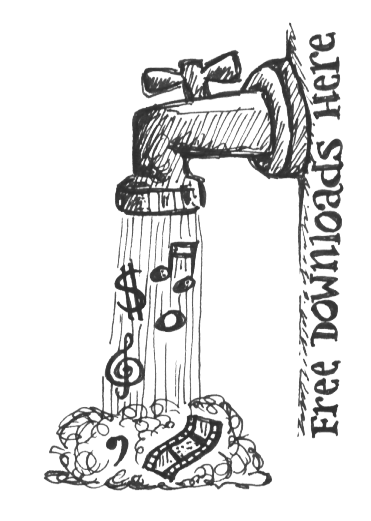
Graphic by Caitlin Daitch

LimeWire and other file-sharing programs allow users to illegally download music and movies for free, before they have been released as an album or onto DVD. What this means is that filmmakers and the hundreds of other people who work to produce a film do not receive the revenue they deserve. While it may seem like it is easier and more cost-efficient to just download the movie instead of going to the theater and paying to see it, the truth of the matter is that this process is stealing and is very much illegal.

The movie industry has struggled to combat DVD and Internet piracy and has recently been making the argument that it is hurting the U.S. economy as a whole. The movie industry loses an estimated $6 billion per year because of illegal film trade, according to reports from the Motion Picture Association of America (MPAA). The consulting firm L.E.K. calculated the reported effect that those losses in sales have on the rest of the economy and found that movie piracy accounts for a total loss of $20.5 billion per year, which translates into the industry not being able to create 140,000 jobs. That then means that there is a loss of more than $800 million in revenue.

The astounding statistics are devastating not only the waning movie industry, but our economy as a whole. While the occasional high-profile film like "X-Men Origins: Wolverine" may gain publicity from leaks (although that is still debatable and probably impossible to readily test), the industry as a whole suffers when these films reach fans before they do theaters.

The film industry, which has given us countless classics that have made us convulse with fear, ache from laughter, tear from sweetness and pulse with excitement is slowly dying. Disinterest in movies thanks, in part, to piracy has caused the film industry to struggle. So as tempting as it may be to illegally download that unedited copy of "X-Men," shut down LimeWire, grab your $10 and go see a movie the old-fashioned way because that's where the magic lies.

Fran Djoukeng says no: piracy is a cheap, efficient way to spread the word among the public and generate hype from a variety of sources.

Enjoying a night on the town at the movies is usually a family-friendly experience, but with the prices of movie tickets and concession food rising exorbitantly, piracy is becoming a valid and beneficial medium of opportunity.

Graphic by Caitlin Daitch
When "X-Men Origins: Wolverine" popped prematurely onto some websites, buzz for the film spawned faster, even making its way onto nightly news coverage. Yet that did not hamper box office sales; instead, it added to the enormous box-office blowout that Twentieth Century Fox reaped from the superhero production: a staggering $87 million. Although the unfinished workprint of the summer blockbuster was leaked online over eight weeks ago, "X-Men" retains the title of the highest grossing-film of the year so far. While movie executives cry about piracy, they seem relatively unperturbed about this latest leak, green-lighting sequels and approving spin-offs based on current success.

Today, the Internet is the ultimate tool for advertising. Piracy is essentially illegal promotion, but is promotion nonetheless. The Internet affords people from different cultures and backgrounds and regions in the world exposure to new tracks, albums, music videos and foreign motion pictures. Though the initial introduction may be free and illegal, the process introduces audiences to new products and companies to new markets.

A leaked version of a film is an effective way to develop consumer trust, allowing buyers a way to view more than just what the studio wants them to see, like trailers that are cut to only show the best parts of a film. As movie executives engage in marketing for an upcoming film, the more omnipresent a film advertisement, the greater chance it will translate into dollar signs (the bottom-line for any and every theatrical release of a production company).

The film and music industries feed the public overinflated estimates about piracy's financial damage. But industry estimates on revenue loss count every incident of piracy as a potential sale, while people who pirate their media for free might think twice if asked to pay for the same product. Granted, there is a drop in potential sales with material that is unsanctioned by a production company, but the movie, music and other outlets of the entertainment industry are still thriving as pirated movies and albums incessantly make blockbuster and platinum status. For those who deem the movie industry as crumbling, a great fallacy lies into this claim. Even given the current woes of the economy, many Americans have been congregating and purchasing tickets at local theaters. For 2009, ticket sales have increased by 17 percent and attendance has been elevated by 16 percent, according to the New York Times.

Piracy is an avenue that encourages wider accessibility for movies, expansive promotion for studio producers and hype-inducing features to the general public which easily increase the sales through legal streams. As the internet is a revolutionizing network of exchange and interaction, no amount of FBI investigation or international crackdown can eliminate the global mechanism of piracy and its effects on the modern entertainment industry.
Digg del.icio.us StumbleUpon reddit Facebook

Discuss this Article

  • glamfabgogurlz on June 1, 2009 at 7:29 PM
    you gurlz are too fab! Jenna-you glamfab, fran-you glamfab
    i love this article more than i love designer handbags.
  • sammy D (View Email) on June 1, 2009 at 8:20 PM
    basically what fran is trying to say is fran loves being a criminal

  • Just somebody on June 1, 2009 at 10:05 PM
    I personally don't pirate music,movies or any sort of media but what makes downloading free music any different from ripping a cd from a friends cd copy? It's free. Artists make more money off of concerts and appearal sold than the CDs itself. The corperate companies and record companies get all that money, not the band its self.
  • The Captain of the Queen's Navy on June 2, 2009 at 12:40 AM
    Only pirates can wear eye patches.
  • Jon Cariba Phoenix on June 2, 2009 at 11:12 AM
    What the entire film industry is dealing (poorly) with is the fact that the entire dynamics of the entertainment industry have changed. This industry hasn't dealt well with some technological changes in the past, but what's happening now might break the camel's back. And here's why:

    Anything like a movie, a song, or computer application involves a lot of effort in making the first copy. In economic term, this means they have a high "embodied" cost. But these same types of things very little to reproduce ~ and thus have low reproduction costs. In the past, movie and song companies set their prices a bit above the reproduction cost in order to make up for the embodied cost, but today that is no longer possible. For the reproduction costs have dropped to almost zero, and that fact plus the internet has made it impossible for the industry to control and pass on costs like they could in the past. And no matter how much posturing comes out of the RIAA or the like, that dynamic isn't changing. The industries know that, and that likely freaks them out.

    Thus, what's necessary now is not a debate over piracy, since that's in the end only a small problem in a much larger issue. What really needs to be figured out is a new production and distribution model for the different parts of the entertainment industry. A way of raising money to finance the embodied costs that is no longer dependent on selling copies of that entertainment.

    Some possible solutions (though possibly not the only ones) is having the industry have either some type of government support, or move in the direction of the open source movement, or both. In the open source movement, hundreds of thousands of developers have created amazing software like Firefox not out of a profit motive, but simply for the joy of programming. In terms of films, this model might mean having more independently financed films, rather than ones that come from the major production companies who care more about box office $$.

    When it comes to independent arts, there likely needs to be some source of seed money, and instead of getting that from a recording company like RCA or advertising revenue, a possible new model of media production would get its money from a variety of sources, possibly including the government. And while some people may be understandably uncomfortable with government-taxpayer money supporting the media, one should understand that our government has always done so. Even in the 1830's, in his book Democracy in America, Alexis de Toqueville wrote about the large number of independent newspapers, many of which received some financial help from the government. So the real question is not whether the government will help the media, but whether they'll help the little guys or the big guys within that media.

    As of now, many large film and music production companies receive tax breaks and subsidies from our government and our tax dollars. If that money is going to prop up a production model that is no longer functional, perhaps these subsidies should be reconsidered. In the meanwhile, we could conceive of a new way of producing media in this country, one that's focused more on helping people promulgate their new songs and ideas, rather than one narrowly focused on profits.
  • qwertyuiop on June 2, 2009 at 5:52 PM
    Did it ever occur to you that movies are so expensive because studios have to compensate for lost sales and that by pirating movies, you're only making the problem worse? Just ask people who've seen the movie or read reviews if you want to know more than what's in the trailer.

    props to Jon Phoenix for writing something more well-thought than the arguments for either side of this issue
    • defff on June 3, 2009 at 12:10 PM
      agreed. piracy is selfish, guys - and, oh yeah, illegal
  • watever on June 3, 2009 at 3:22 PM
    why are yall trying act all holier than though? you know straight up that yall use bootleg sites and illegally pirate songs and movies so you shouldnt be talkin. yall wack and phenix didnt even answer the pro/con ? so his argument is off base
  • loll on June 4, 2009 at 8:51 AM
    i just think this pro/con is kinda pointless
  • Jon Phoenix on June 6, 2009 at 5:57 PM
    I understand what "watever" is saying, and I thank him or her for the comment. Please understand that I was trying to shed some light on the underlying dynamics of media that creates this issue. Because I think only through doing that can this issue be solved. This particular pro\con debate I think is decent, the writers did well, but this particular pro\con debate question needs to be linked to its underlying causes for the problem to ultimately be solved.
  • Wylie on June 9, 2009 at 11:57 PM
    The pirate party just won two seats in the European Parliament. Clearly piracy is good.
Leave a Comment