Inside the fight over MCPS cell towers
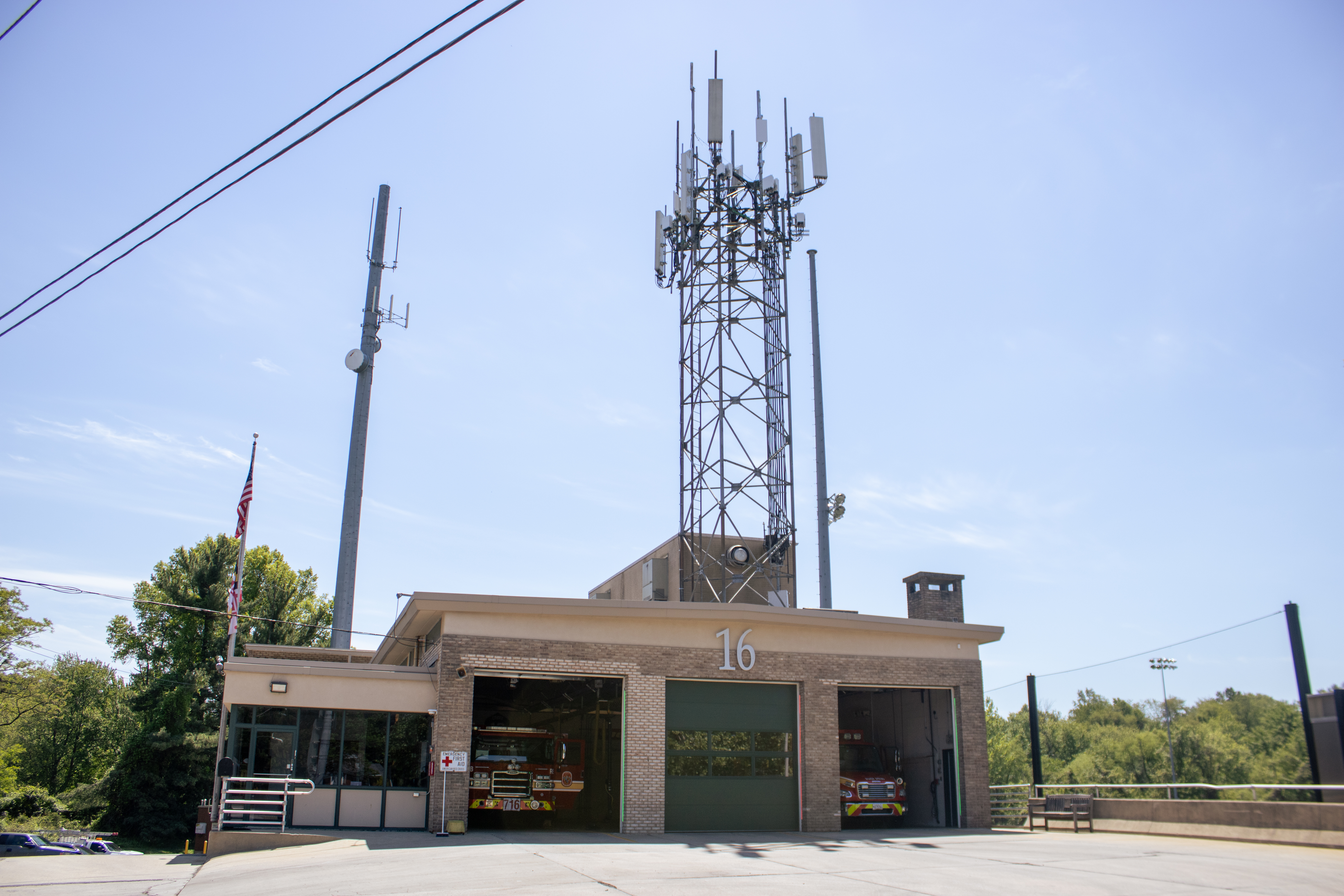
The cell tower next to Blair has been a subject of constant debate for many years. Photo courtesy of Bruno Resetarits.
It’s a crisp spring night at Blair and the building services workers are just closing shop. Amid the crashing voices of students and teachers, the school is relatively calm and free of conflict. The lights of Four Corners glimmer in the distance. The cars rush by in seamless motion. Yet within a few feet of the seemingly serene campus stands a lofty structure, where the noise and conflict of the day linger long after nightfall: the cell tower.
Sitting adjacent to the local Silver Spring fire station, the tower has long been a subject of intense debate between politicians and activists in the area. On one hand, some environmental activists posit that the towers can cause health issues such as brain damage or cancer. They also believe that the placement of such towers has been unfair, disproportionately affecting lower-income school zones. On the other hand, many politicians believe that the supposed health risks of cell towers are negligible. They believe that the towers actually add economic value to the area and that the uproar of activists has encouraged more radical beliefs.
Recently, there has been much debate in our area about the issue, and the divide has only grown more pronounced as both sides attempt to support their convictions. As concerns for public health, privacy, equity, and safety converge, cell towers have proven to be a larger issue than just Blair or MCPS. To better understand these two perspectives, we will examine each through the eyes of some of their biggest proponents.
Theodora Scarato
On Feb. 5, 2026, the MCPS board of education met to discuss budget strategy, collective bargaining negotiations, and legal advice concerning contractual and litigation matters. Among those who testified, local mother and social worker Theodora Scarato highlighted the forgotten issue in a two-minute testimony backed by scientific data and comparative examples from numerous counties. However, she wasn’t new to the tables at the board; in fact, her advocacy extends back more than fifteen years to the time she first emailed SCO about the issue in 2012.
Through her social work role, she grew deeply passionate about learning about the impacts on the brain of prenatal drug use. In some cases, she encountered clients who were born with certain neurological differences, and research intrigued her to focus on Radiofrequency (RF) radiation’s impact on the brain by way of cell towers. Scarato published numerous studies, notably one which included over 250 scientists from around the world, and most support her claim that children are the most vulnerable to RF radiation’s neurological effects.
“When I read about the study showing impacts to the brain, knowing what I know about even small impacts to the brain when you're young, that got me researching this,” she says.
Her concerns extend directly to Blair. While the tower adjacent to the fire station near the school currently has no active carriers, Scarato warns that the situation remains precarious. "Every tower that exists can have more antennas added with very little public process or participation," she says. She also points to the cluster of nearby towers surrounding the campus. "There are cell towers around the school that are very nearby, so the levels are elevated, I would expect, compared to if you were further away." Blair, she argues, is far from an isolated case. At least ten MCPS schools — including Einstein, Magruder, Wheaton, Springbrook, and Northwood — have cell towers on or near their grounds. At Daley Elementary, parents have circulated a petition demanding that the tower be removed entirely. "School should be for education," she says. "And so now what do we do about the tower? That shouldn't be a part of the conversation."
Prior to her recent testimonies, Scarato and petitioners from the Environmental Health Trust sued the Federal Communications Commission (FCC) to explain how RF radiation limits across the country protect the American public from long-term exposure. The case ended in the court mandating the FCC to show proper evidence on its record related to non-cancer health effects. However, five years after the case, the FCC has not responded to the court’s order. Scarato also notes that the existing limits are particularly troubling. "Our limits are from 1996, and they're based on studies of little animals exposed to very high levels for under an hour," she says. "Our limits are not based on long-term exposure."
Similarly, Scarato’s experience with institutional data transparency remains challenging at the county level. “I have written MCPS to get all the information transparent on all of this, and was told that it would cost $500 to get all the information I asked for, even though other counties already have this information up,” she says. She wants to know which schools have towers, which carriers are on them, what the leases say, and what RF radiation levels look like in school buildings and on athletic fields. When she pressed one tower company operating in Montgomery County about whether it conducted regular radiation tests, the response floored her. “They said, 'Oh yeah, we do yearly tests,'" she recalls. “And I said, 'Can you send me those?' They didn't answer for many weeks, and then they wrote me that it was proprietary."
Her proposed solutions remain complicated. In the short term, she believes MCPS should follow the lead of Loudoun County, Palo Alto, and San Francisco, all of which have banned new cell tower leases on school property. "There are many school districts that have passed prohibitions on any new cell tower leases," she says. "To me, that is a common-sense approach." She is also pushing for the county to track and publicly account for the rent payments it receives from telecom companies for tower placement. "Where does the money go?" she says. "It's not in the budget. It has unaccounted funds that should be accounted for and tracked." In the long term, she believes the wireless industry itself needs to compete on safety, designing networks that reduce EMF exposure."It absolutely can be done," she says, "however, it will only be done if people ask for it." That process of consistently petitioning for a cell tower change has been Scarato’s most relentless and defining commitment.
Hans Riemer
On the other side of the issue is Hans Riemer, a former Montgomery County council member and politician. Riemer, who now works for a solar energy company, views Scarato’s claims in a completely different light.
"Banning these antennas is really the same as banning Wi-Fi routers in our homes," he says. "And we don't ban Wi-Fi routers in our homes for obvious reasons." During his tenure, one of his central goals was to legalize the placement of small cell antennas on telephone poles and light poles throughout the county. When he discovered how zoning laws in the county could counteract his plan, he set out to change things, which often led to direct opposition with Scarato and other activists.
Soon, activists began showing up to public hearings, testifying against the antennas and raising health concerns. Riemer says he took those concerns seriously enough to investigate them himself, consulting what he describes as some of the top experts in the world on the issue. What he found left him unconvinced.
"There is, first of all, no theory of how that part of the spectrum would cause a health problem," he says. For radiation to cause cancer, he explains, it would need to damage DNA, which is something only X-ray level radiation is capable of. The non-ionizing spectrum used by wireless devices simply doesn't work that way. "There are waves there, but if you are walking down the street and there's a light breeze, a light breeze is never going to knock you over,” Riemer points out. “But if there's a tornado, a tornado could lift you off the ground and cause harm. That's the difference between the safe side of the spectrum and the dangerous side."
Riemer also points to two decades of real-world data to make his case. Since the mid-2000s, wireless has become almost universal. Most households carry dozens of devices, and people are exposed to the spectrum around the clock. "We've had 20-plus years of every home having Wi-Fi, everybody having multiple devices on their bodies, in their pockets, in their hands, next to their heads, at all times," he says. "Guess what? There's no health impact that you can identify with that. It's case closed." He acknowledges that some critics will point to isolated findings, but he still remains dismissive of that approach. "There will be some who will cherry-pick and say, 'Oh, well, there's this certain thing that has happened,' but you can't explain why that would in any way be correlated with Wi-Fi," he says.
On the equity argument that is most often wielded by Scarato, Riemer is also skeptical. He notes that the tower near Blair sits on fire station property, not school grounds, and argues that strong wireless coverage is a safety asset for any school, rather than a negative. "It's actually a big advantage for the school to have a tower right there," he says. "If there's ever an incident at school, you want to be able to contact your family." He also pushes back on the framing of the equity argument itself. "It's a funny way to talk about equity to say we are providing more powerful communications capacity, and she says that's a bad thing," he says. "What if we provided free Wi-Fi in the homes of everybody who's low-income in Montgomery County? She looks at it as if it’s bad that you're providing that. [Scarato’s] really looking at it from exactly the wrong direction."
Still in the air
As the debate over cell towers continues to play out in county council chambers and board of education meetings, the tower next to Blair stands largely unbothered. For Scarato, it represents a public health crisis hiding in plain sight, one that disproportionately hurts the students least equipped to push back. For Riemer, it represents the county’s progress: reliable connectivity, economic value, and a safety net for thousands of students who might one day need to reach their families in an emergency.
What's clear is that the fight is far from over. Both sides have continued to press on the issue, and as 5G infrastructure continues to expand across Montgomery County, the questions at the heart of the debate will only become harder to ignore. For now, the tower stands in the night sky. The cars rush by unnoticed. And the problem of the cell tower still lingers in the air.
Mooti Chimdi. Hi I'm Mooti (he/him). Besides writing for SCO, I love trying new foods in D.C. and running hurdle events for Blair's track team. More »
Joe Newman. Hi, I'm Joe Newman. I'm a senior here at Blair and this is my second year on SCO. I play tennis, soccer, and I run cross-country. I'm also really into religion and philosophy, and I love having deep discussions with others. Oh, y no se … More »
Please ensure that all comments are mature and responsible; they will go through moderation.
