Why are devices so much more expensive now?
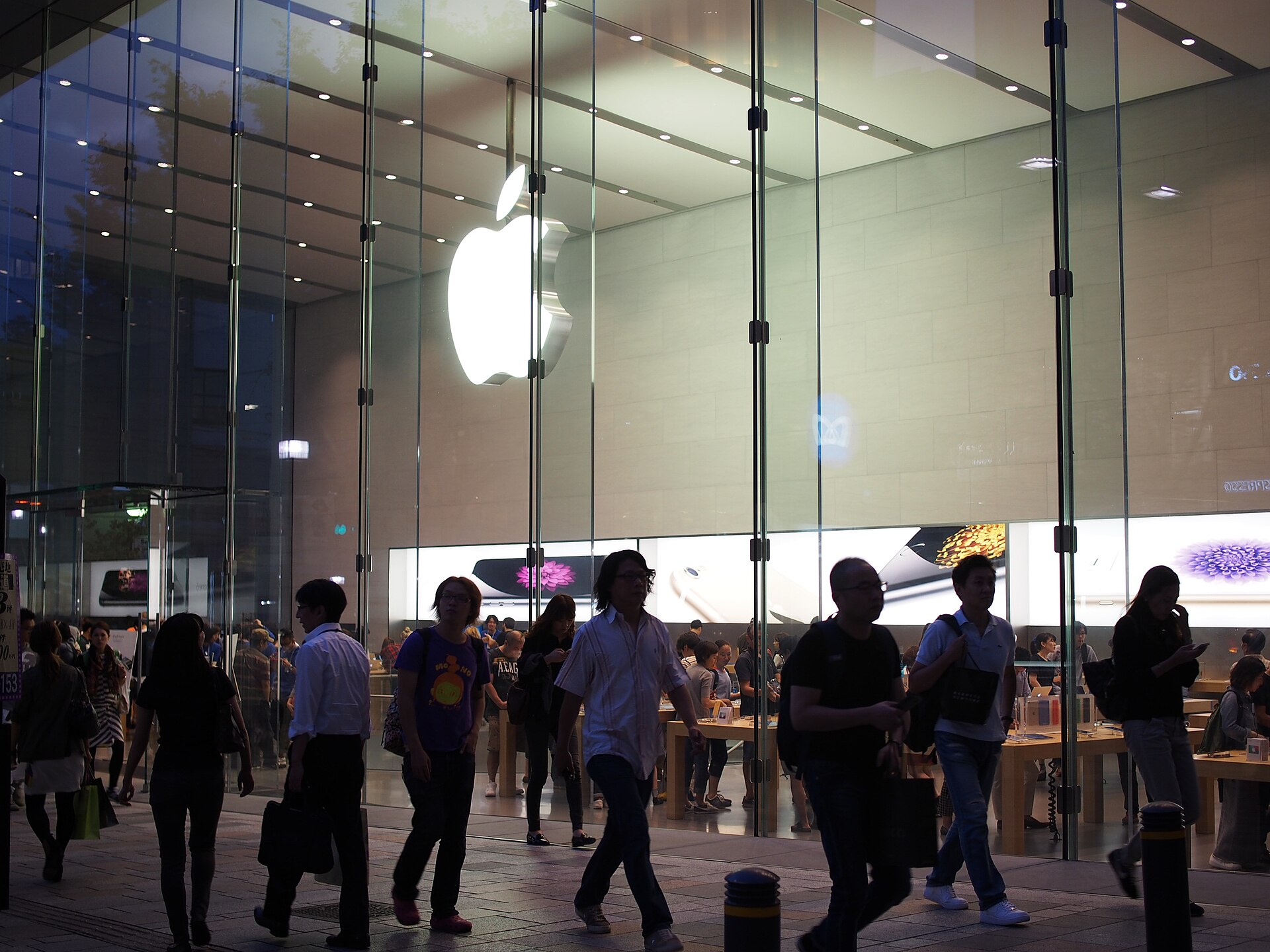
Customers shopping at an Apple store in the fall. Photo courtesy of Wikimedia Commons. Photo courtesy of Wikimedia Commons.
In December 2024, customers could snag an Xbox Series S on Amazon for $248.00; today, the best deal on the platform is $498.00. From smartphones to laptops and more, over the last several months, the market has seen some of the largest year-over-year price hikes since the COVID-19 pandemic. The tech market has experienced this major inflation due to advancements in AI infrastructure, with experts predicting that it will only worsen in 2027 and beyond. Every year on Black Friday weekend and throughout the holiday season, customers flock to the stores for big savings on iPhones, Chromebooks, or consoles. But because of these recent events, they may be disappointed by the ‘sales’ that are offered this year.
Recent price hikes on tech hardware can be attributed to the global shortage of computer memory. Since summer 2025, technology corporations have invested over $350 billion into AI data centers that power new agentic systems. A critical component of these data centers is called random access memory (RAM) and it processes active programs and files so that a device can interact with them quickly. However, as tech companies purchase more RAM for data centers, less of it becomes available for consumer electronics. As a result, RAM suppliers have sharply increased prices for customers like Apple and Sony, and slowly but surely, these costs have been pushed onto consumers. For example, with the iPhone 18 Pro, the Wall Street Journal estimates that Apple paid $145 for RAM in each unit, which is 3.7 times more than the $39 that Apple paid for the iPhone 17 Pro last fall, thus leading to a $100 consumer price increase for the product year-over-year. Because of this significant added cost on manufacturers, many tech companies are unable to discount products this holiday season at the same level as in previous years.
Arun Maini, a tech analyst known online as Mrwhosetheboss, investigated how this inflation began behind-the-scenes. Maini claimed that, in recent history, major tech companies really haven’t been “behaving like businesses. They’re spending more money than they’re even making from AI because the fear of losing the AI race has actually become bigger than the fear of debt…[putting] memory companies in such a powerful position that it feels like they’ve just decided to forget entirely about the consumer.”
Tech companies build data centers by constructing them out of chips, or pieces of silicon with specific components to carry out computationally intensive tasks, one of these being the RAM. However, corporations buy chips in racks to purchase them in bulk; when purchasing the Nvidia Blackwell Ultra, a common chip used for these data centers, a typical rack contains 72 chips, which would provide enough RAM to power 1,300 PlayStation 5 consoles. Furthermore, these companies often purchase racks in clusters; when Microsoft opened its first NVIDIA-powered cluster in 2025, it contained 64 racks of chips, or enough RAM to manufacture 83,000 PlayStation 5 consoles. According to a report from Tom’s Hardware in January 2026, AI data centers are now consuming around 70% of the global memory output, leaving all consumer electronics to fight for the remaining minority percentage.
Over the course of this past year, the newfound scarcity and added costs of RAM have caused virtually all consumer electronics to increase in price. For example, on June 17, 2026, Apple’s then-CEO, Tim Cook, told The Wall Street Journal that price hikes on Apple products were “unavoidable. Just over a week later, every iPad and Mac in their product line increased by at least $100 in price, with some prices rising as much as 30% overnight. Similarly, the price of Sony’s PlayStation 5 increased by $50 in August 2025 and another $100 in April 2026, now starting at $649.99.
This Black Friday and holiday season, retailers like Best Buy and Amazon will advertise big discounts, just as they have each year. However, because of this ongoing situation, the savings that are offered will be quite modest. For example, the most affordable iPad, which was discounted at $271.29 on Amazon during Black Friday weekend, is now being advertised as a discount for $379.00. Similar observations can be made about popular televisions, cameras, Kindles, and smartwatches; the list goes on and on. So how can interested buyers get the best financial value out of their purchases?
Boone Ashworth, a tech analyst at WIRED, a popular tech news magazine, provided some tips for tech shopping this Black Friday season, as well as some pessimism for the future. As reported in his article, according to Jitesh Ubrani, the director of Consumer Devices Research at the International Data Corporation, products will “‘probably continue to get more expensive well into 2027 [as the RAM crisis continues, especially] when it comes to PCs, tablets, [and] those kinds of devices.’”
Ashworth offered specifics on recent price hikes from companies like Amazon to further corroborate that prices won’t dip much lower in the near future. However, he noted that savings will vary based on the type of device consumers are looking for; “gadgets like robot vacuums, headphones, and other products that don’t rely as much on memory may see better prices” when compared to smartphones and computers. Additionally, Ashworth highlighted the potential benefit of seeking refurbished products from reputable retailers, as tech companies are putting heavier emphasis on buying back their own products to increase stock of refurbished items. This allows them to lower prices to more accessible figures for consumers, bringing the sticker price much closer to Black Friday deals from the past.
Finding truly great holiday deals will be much harder than in previous seasons, and according to Ubrani, “we’re going to face elevated prices for years [to come].” But fortunately, most modern hardware has better longevity than technology offered in previous years, allowing customers to hold onto them for longer periods of time. Additionally from certified refurbished programs, tech companies are implementing new strategies to make increasingly expensive hardware more accessible. For example, in August 2026, T-Mobile introduced its EIP Flex 36 phone plan to let customers finance a new phone and all associated upgrade fees over 36 months with no upfront payment or monthly interest. Furthermore, Apple launched its Apple Upgrade Program in July 2026 to let customers lease a number of its products for 12 or 24 months. Inside of this program, an iPhone 17 leased over 12 months is just $443.88, over 50% cheaper than buying outright, and customers can return it or upgrade to the latest model once their leasing period is over.
These efforts can offer some relief to consumers and help companies maintain their sales numbers in the midst of the RAM crisis. Rising costs for technology are a natural inevitability, and prices aren’t guaranteed to decrease once the memory shortage stabilizes. But while deals may be modest this season, these resources offer alternative ways to get tech that doesn’t break the bank.
Logan Thomas. Staff Writer More »
No comments.
Please ensure that all comments are mature and responsible; they will go through moderation.
